
B. Section One: The Domains
Human beings live with needs. We need to survive, to be secure, to belong, to develop, to compete, to achieve, and, ultimately, to become what we aspire to be. Some needs are basic and biological; others are social, psychological, economic, political, cultural, and even existential. Human civilization can therefore be understood, at its deepest level, as a continuous effort to fulfil human needs.
But human beings do not fulfil all their needs in the same way, nor through the same institutions. Some needs are fulfilled by ourselves. Some are fulfilled through our relationships with other people and communities. Some are fulfilled through economic exchange with businesses and markets. Some require collective organization through government and the state. And, fundamentally, all human fulfilment depends upon the natural and ecological systems that sustain life. This suggests that human life can be understood through five interconnected domains of human need fulfilment: Individual, Social, Economic, Political, and Ecological.
1. From Human Need to Human Demand
A human need is a condition necessary or desired for human survival, development, security, participation, achievement, or fulfilment. However, a need does not automatically become a demand. A need becomes a demand when an individual recognizes, articulates, and seeks something to satisfy that need. Demand is therefore the observable manifestation of human need. The relationship can be expressed simply as:
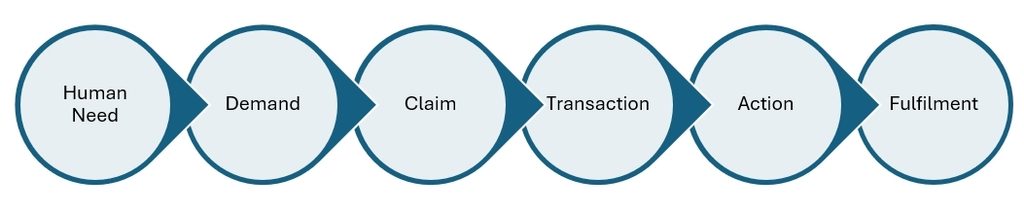
A person who needs food develops a demand for food. A person who needs security develops a demand for protection. A person who needs knowledge develops a demand for education. A person who needs belonging develops a demand for family, friendship, or community. A citizen who needs justice develops a demand for a functioning legal and political system.
Thus, demand is not exclusively an economic concept. Economics traditionally speaks about demand for goods and services. But human beings also have demands upon themselves, upon other people, upon communities, upon governments, and—although not necessarily in the form of a conventional transaction—upon and within ecological systems. Human demand therefore extends far beyond the marketplace.
2. Five Domains of Human Need Fulfilment
The central proposition is that human needs are fulfilled through five interconnected domains (1) Individual — I fulfil myself; (2) Social — We fulfil one another; (3) Economic — We exchange to fulfil our needs; (4) Political — We organize collectively to fulfil our needs; (5) Ecological — Nature sustains and enables human life.
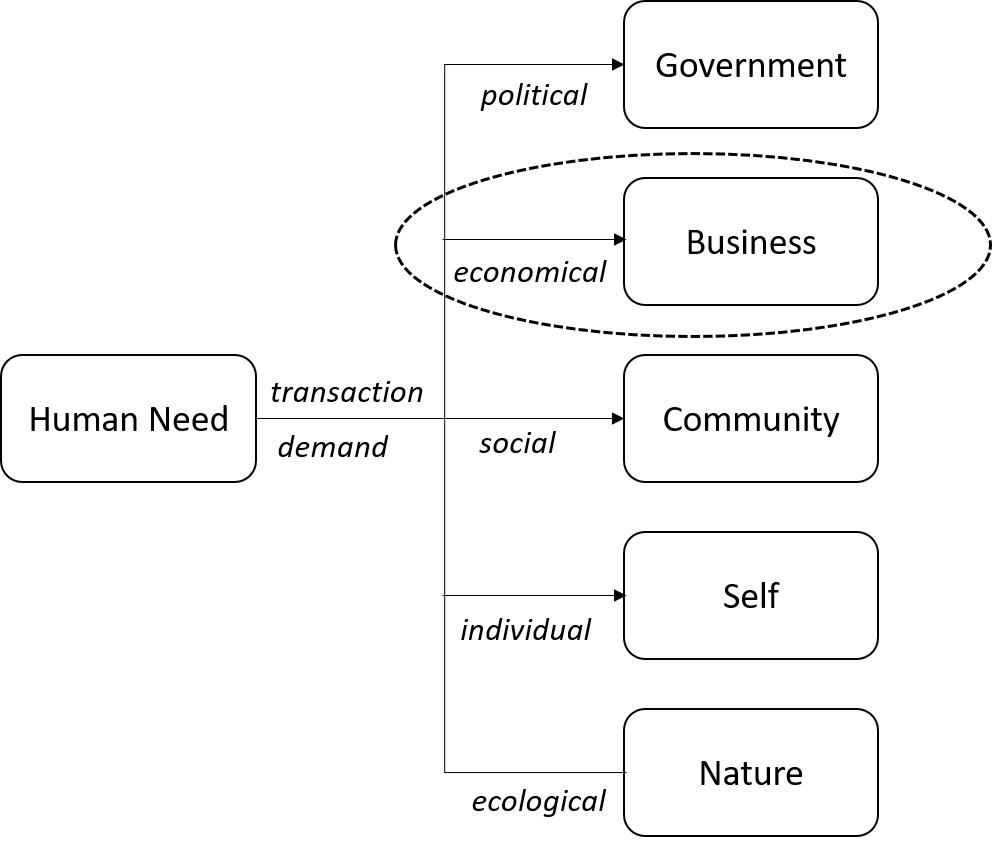
These five domains should not be understood as five separate worlds. They overlap, interact, and depend upon one another. A single human need may involve several domains simultaneously. Consider something as simple as food. An individual may grow or cook food for oneself. That is individual fulfilment. A family may prepare and share food together. That is social fulfilment. A person may purchase food from a business. That is economic fulfilment. The government may regulate food safety, provide food assistance, or maintain agricultural infrastructure. That is political fulfilment.
And all food ultimately depends upon soil, water, climate, biodiversity, sunlight, and other ecological systems. That is ecological dependence and fulfilment.
The same human need can therefore have a multi-domain fulfilment portfolio.
3. The Individual Domain: I Fulfil Myself
The first domain is the Individual. Human beings are not merely consumers of resources provided by others. They are also producers of their own capabilities and well-being. Individuals learn, work, think, exercise judgement, develop skills, create, discipline themselves, care for themselves, and make decisions. Education is not only something purchased from a school or university. A substantial part of learning is self-directed. Competence is not simply supplied by an employer. It is also built through individual effort. Achievement is not simply delivered by society. It requires personal agency.
The individual domain therefore represents self-provisioning and self-development. Its central proposition is: I fulfil myself. This domain becomes increasingly important as human development progresses, because greater individual capability increases the capacity to fulfil needs through all other domains. An educated individual can participate more effectively in markets, communities, and political institutions.
4. The Social Domain: We Fulfil One Another
The second domain is Social. Human beings are fundamentally relational creatures. Many of our most important needs cannot be adequately fulfilled by individual effort or market exchange. Love, belonging, friendship, trust, identity, recognition, care, solidarity, and mutual assistance are fundamentally social. A parent cares for a child. Friends support one another. Neighbours help one another. Communities protect their members. Professional associations create identity and belonging.
These activities may involve little or no monetary exchange, but they nevertheless produce enormous human value. This is the domain of family, friendship, community, association, solidarity, social capital
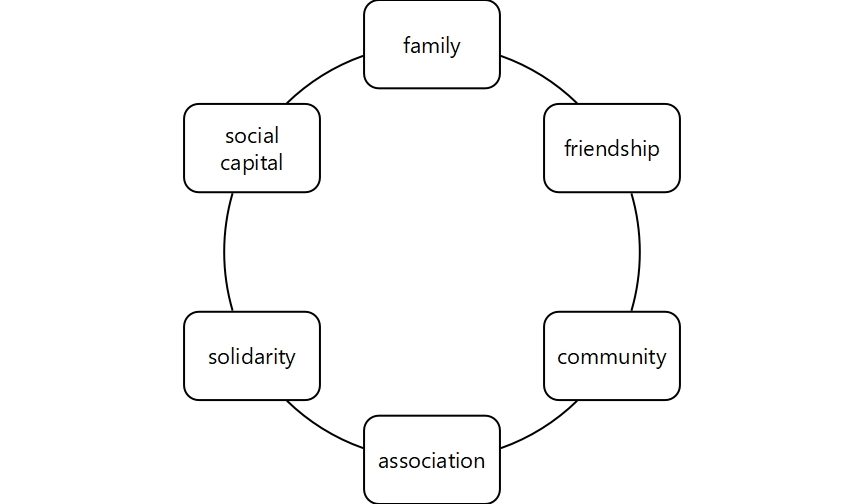
Its central proposition is we fulfil one another. This also explains why GDP cannot be a complete measure of human welfare. Much of what makes human life valuable is produced through relationships that are not fully captured by market transactions.
5. The Economic Domain: We Exchange to Fulfil Our Needs
The third domain is Economic. As human societies develop, people increasingly specialize. One person becomes a farmer, another an engineer, another a teacher, another a doctor, another a software developer, another a manufacturer. Because no individual can efficiently produce everything needed for life, specialization creates the need for exchange. This produces the economic system.
Businesses and markets become mechanisms through which human beings obtain goods and services that they do not produce themselves. Food, housing, clothing, transportation, energy, technology, finance, entertainment, education, healthcare, and countless other goods and services are provided through economic activity.
The individual therefore becomes consumer, worker, entrepreneur, investor, owner. Economic demand is the most visible form of demand in modern society because it is expressed through prices and monetary transactions. But we should remember, economic demand is only one manifestation of human demand.
The market can provide many things exceptionally well, but it cannot by itself fulfil every human need. It can sell a house, but not necessarily a home. It can sell communication technology, but not necessarily friendship. It can sell education, but not necessarily wisdom. It can sell security systems, but not necessarily justice. This is why the economic domain must be understood as one component of the larger system of human fulfilment.
6. The Political Domain: We Organize Collectively to Fulfil Our Needs
The fourth domain is Political. Some human needs are collective in nature and cannot be adequately fulfilled through individual action or ordinary market exchange. Security, justice, public order, national defence, public infrastructure, regulation, public health, social protection, and the protection of rights require collective organization. This is where the state emerges.
The relationship between citizens and government can itself be understood as a form of political exchange, although it is fundamentally different from market exchange. Citizens contribute: taxation + compliance + participation + legitimacy; while expecting: security + justice + public goods + rights + protection + collective capability. Thus, political demand is the demand individuals and groups make upon collective authority.
Its central proposition is, we organize collectively to fulfil needs that cannot be adequately fulfilled individually or through markets alone. Politics, therefore, is not merely about elections, parties, or the acquisition of power. At its deeper level, politics concerns the collective allocation of rights, resources, responsibilities, risks, and opportunities.
7. The Ecological Domain: Nature Sustains and Enables Human Life
The fifth domain is Ecological. This domain requires a conceptual distinction. We can transact with a business. We can make claims upon government. We can exchange with other people. We can act upon ourselves. But we do not transact with nature in exactly the same sense.
Nature does not necessarily present a bill to us when we extract water, minerals, energy, timber, or other resources. Nor does an ecosystem negotiate a price when it provides clean air, fertile soil, biodiversity, climate regulation, or water purification. Yet these ecological services are indispensable to human existence. Human beings obtain food, water, oxygen, energy, land, minerals, biodiversity, ecosystem services from ecological systems. At the same time, human activity affects those systems through extraction, pollution, depletion, transformation, conservation, restoration, regeneration.
Therefore, the relationship between humans and nature is better understood as ecological interdependence or human–nature reciprocity, rather than simply transaction. Its central proposition is nature sustains and enables human life.
This is why I use the term ecological rather than merely environmental. “Environmental” tends to describe nature as something surrounding human beings. “Ecological” emphasizes relationships, interdependence, and systemic dependence. This distinction is fundamental.
8. Ecology Is Not Simply the Fifth Domain
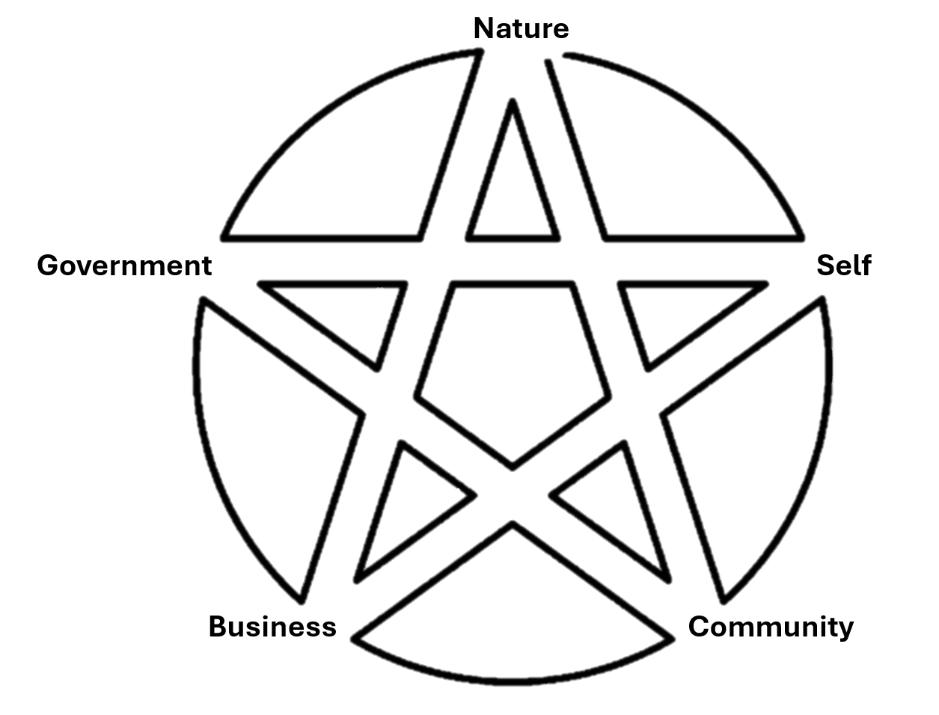
There is an even deeper implication. The five domains should not be represented as five equal boxes. Ecology is different because it constitutes the foundation upon which the other four domains ultimately depend. We can therefore visualize the structure as:
This is not a chronological sequence. It is a dependency structure. The economy depends upon society. Society depends upon individuals. Political institutions depend upon individuals and society. And all of them ultimately depend upon ecological systems. Therefore, the economy is not the whole system of human fulfilment. It is one domain within a larger human–social–political–ecological system.
9. Can We Assign Percentages?
This raises an important methodological question, what percentage of human needs is fulfilled by each domain? A precise empirical percentage does not really exist, because the domains overlap. A person’s need for healthcare, for example, can simultaneously involve individual behaviour, family support, a hospital business, government regulation, and ecological conditions. Therefore, it would be misleading to claim that exactly 35% of human needs are economic, 25% individual, and so forth.
However, as a heuristic framework, we can construct an indicative allocation of the relative importance of each domain in the observable process of human need fulfilment:
| Domain | Indicative share | Principal mechanism |
| Economic | 35% | Market exchange, goods, services, employment |
| Individual | 25% | Self-development, work, learning, agency |
| Social | 20% | Family, community, reciprocity, care |
| Political | 15% | Public goods, security, justice, regulation |
| Ecological | 5%* | Direct provisioning and ecological services |
| Total | 100% |
The numbers should be treated not as statistical facts, but as an analytical starting point. More importantly, the 5% ecological figure must never be interpreted to mean that nature contributes only 5% to human welfare. The opposite is closer to the truth. Ecology may represent a relatively small proportion of directly perceived human transactions, while simultaneously representing the foundational condition of almost all other forms of fulfilment. In other words, low direct visibility does not mean low systemic importance. A forest may not appear as a transaction on a household balance sheet, yet it may support water, agriculture, climate stability, biodiversity, and ultimately economic production itself.
10. Human Need Has a Fulfilment Portfolio
A more sophisticated way to think about the five domains is therefore not to assign one fixed percentage to humanity as a whole. Instead, each human need has its own fulfilment portfolio. For example, food. Economic may dominate through purchasing food. Social may contribute through family provision. Individual may contribute through cooking or growing food. Political may contribute through food security policy. Ecological systems provide the underlying soil, water, climate, and biodiversity.
Security. Political fulfilment may dominate through law enforcement and defence. Social fulfilment comes through family and community. Individual fulfilment comes through personal capability and preparedness. Economic fulfilment comes through insurance and security services. Ecological stability provides the broader conditions for social stability.
Belonging. Social fulfilment may dominate through family, friendship, and community. Individual fulfilment contributes through identity and personal development. Economic institutions may provide workplaces and organizations where people build relationships. Political institutions may provide citizenship and collective identity. Ecological places may contribute to cultural and community identity.
Thus, there is no single percentage distribution for all human needs. Each need has a different fulfilment portfolio across the five domains. This is a much stronger proposition than trying to force all human needs into a single economic framework.
11. The Deeper Meaning: Civilization as a System of Need Fulfilment
From this perspective, civilization itself can be understood as the progressive organization of human need fulfilment. At a very basic level, humans fulfil needs themselves. Then they discover that cooperation allows them to fulfil needs more effectively. Cooperation produces families and communities. Specialization produces division of labour. Division of labour produces exchange. Exchange produces markets and businesses. Increasing social complexity produces institutions. Collective problems produce governments and states. And throughout this entire process, ecological systems provide the material and biological foundation. The broad historical movement can therefore be represented as:
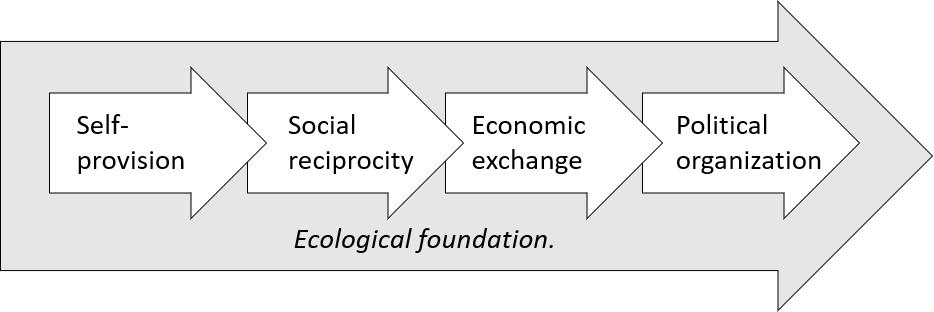
This provides another way to understand the emergence of civilization.
Civilization is not simply the accumulation of technology, wealth, or political power. It is also the increasing sophistication with which human beings organize themselves to fulfil human needs.
12. The Central Proposition
The framework ultimately leads to a simple but powerful proposition: Human welfare is not produced by the economy alone. It is co-produced by individuals, communities, markets, governments, and ecological systems. Or, more formally:
Human Need Fulfilment = f(Individual, Social, Economic, Political, Ecological)
The five domains are interconnected rather than independent. An improvement in one domain can strengthen another. Better education strengthens individual capability, which strengthens economic productivity. Stronger communities increase trust, which can reduce economic and political transaction costs. Better political institutions can create the security and rules necessary for markets to function. A healthier ecological system can sustain agricultural productivity, public health, and economic activity.
But the reverse is also true. Economic growth can weaken social cohesion. Political intervention can distort economic incentives. Individual competition can weaken community. Economic extraction can damage ecological systems. Political decisions can accelerate or restrain ecological degradation. Therefore, the real question is not simply of how much does the economy grow; it is how effectively does a society transform its ecological, individual, social, economic, and political resources into human fulfilment. That is a much broader definition of development. And perhaps the ultimate objective of development should therefore not be economic growth, but the expansion of human capability and well-being through a balanced and sustainable system of individual, social, economic, political, and ecological fulfilment.
B. Section two: business matter
Among the five domains of human need fulfilment, the economic domain occupies a distinctive position. It is the domain in which human needs are transformed into economic demand and fulfilled through exchange with businesses, markets, and other economic actors.
Economic Fulfilment: Business as the Mechanism of Exchange
Human beings cannot efficiently produce everything they need by themselves. As societies become more complex, individuals increasingly specialize in particular activities, occupations, skills, and forms of production. Specialization creates interdependence: people produce some things for themselves, but rely on others for many of the goods and services necessary for their lives.
This is the fundamental reason why economic exchange emerges. A person may need food, but does not necessarily grow it. A person may need transportation, but does not manufacture a vehicle. A person may need information, communication, healthcare, finance, entertainment, or technology, but cannot efficiently produce all of these services individually. Instead, human beings exchange their labour, income, capital, skills, or other resources for goods and services produced by others.
The economic domain can therefore be understood through a simple sequence: Human Need to Economic Demand, to Market Exchange, to Business Provision, to Need Fulfilment. In this process, business is not merely an institution that sells products. Business is an organized mechanism through which society converts human needs into products, services, innovations, employment, and economic value.
From Need to Demand. The starting point of economic activity is not the product but the human need. People do not fundamentally demand automobiles, smartphones, hotels, insurance, restaurants, or financial products. They demand what those products enable them to achieve.
A person may purchase an automobile because they need mobility. A smartphone because they need communication, information, or connection. Insurance because they need security against uncertainty. A hotel because they need temporary accommodation. Education because they need knowledge and capability.
This distinction is important: businesses do not ultimately exist because people need products. They exist because people have needs that products and services can help fulfil. Economic demand is therefore a market expression of human need.
However, not every human need becomes economic demand. A need becomes economically actionable when it is supported by purchasing power, willingness to exchange, and the availability of a provider.
Thus, need is universal, but economic demand is conditional. A person may need healthcare but lack the purchasing power to obtain it. A person may desire education but be unable to afford it. A community may need clean water even when there is no commercially viable market for supplying it. This is one of the fundamental boundaries of the economic domain.
Business as the Institutionalization of Exchange.
Business exists because exchange creates mutual value. The consumer possesses purchasing power and a need. The business possesses resources, capabilities, knowledge, technology, and organizational capacity to provide a solution. The transaction occurs when both parties perceive that the exchange improves their position.
The customer receives a complete set of fulfilment: utility, solution, convenience → experience. While the business receives revenue, margin, capital, growth, and finaly organizational survival. Economic exchange therefore creates a reciprocal relationship. Customer value enables business value, while business value enables customer fulfilment. This is why the fundamental purpose of business cannot be reduced simply to selling. Selling is the visible act. Value creation is the deeper economic function. A business survives when it can repeatedly transform resources and capabilities into something that customers consider sufficiently valuable to exchange for it.
The Business Value Chain of Human Fulfilment.
From the perspective of human need, the business process can be understood as a transformation from Need to Insight, to Solution, to Product/Goods or Service, to Exchange, to Experience, then to Fulfilment. The business begins by identifying a need, whether expressed or latent. It then mobilizes resources, technology, knowledge, people, capital, and organizational capabilities to create a solution. The solution is embedded in a product or service. The product or service enters the market through an exchange.
The customer then uses or experiences it. The ultimate outcome is not the transaction itself, but need fulfilment. This distinction is critical. A transaction may occur without meaningful fulfilment. A customer may buy a product that does not solve the underlying problem. A service may be delivered but fail to create the expected value. A product may generate short-term consumption but little durable welfare. Therefore, transaction is not the same as fulfilment. Economic activity should ultimately be evaluated by the extent to which transactions create genuine value and contribute to human well-being.
Economic Fulfilment Is More Than Consumption.
It is also important not to equate economic fulfilment with consumerism. Individuals participate in the economy in several roles of consumer plus worker plus entrepreneur plus investor plus owner.
As consumers, people obtain goods and services; as workers, they exchange labour and skills for income, identity, experience, and opportunities for development; as entrepreneurs, they create solutions for the needs of others; as investors and owners, they provide capital and participate in the creation and distribution of economic value.
Economic fulfilment is therefore a two-way process. People do not merely receive value from the economy. They also contribute value to the economy. This produces a fundamental economic cycle:
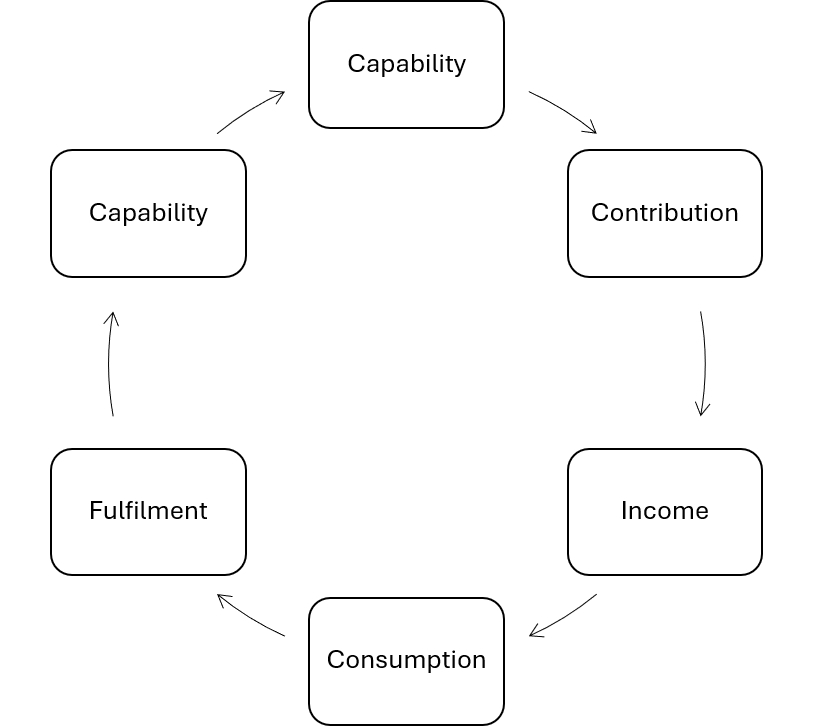
A person develops capabilities, contributes them through work or entrepreneurship, receives income or other economic returns, uses those returns to fulfil needs, and hopefully reinvests in further capability development. A healthy economy therefore does not merely maximize consumption. It expands the capacity of people to participate meaningfully in value creation and exchange.
Business and the Other Four Domains.
Economic fulfilment does not operate independently from the other domains of human need fulfilment. Business depends upon individuals because individuals provide labour, entrepreneurship, knowledge, creativity, and consumption. Business depends upon society because markets require trust, relationships, norms, cooperation, and social capital.
Business depends upon government because economic exchange requires property rights, contracts, infrastructure, regulation, monetary institutions, and political stability.
And business ultimately depends upon ecological systems because economic production requires energy, materials, land, water, biodiversity, and ecological stability.
Thus, the economic domain is embedded within a larger system:
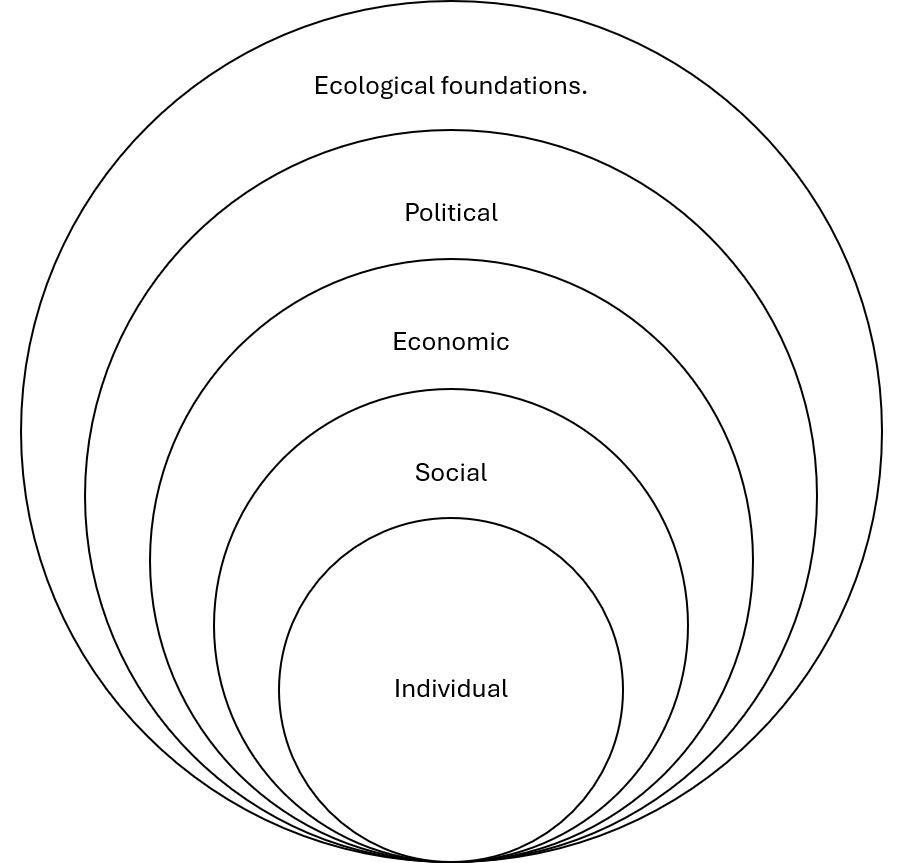
This means that the economy is neither autonomous nor self-sufficient.
It is a socially embedded and ecologically dependent system of exchange.
From Economic Growth to Economic Fulfilment
This distinction also raises an important question about the meaning of economic growth. An economy can grow because more transactions occur. But more transactions do not automatically mean greater human fulfilment. GDP can increase through the production and sale of goods and services, yet human welfare may not increase proportionately.
The central question should therefore move from how much economic activity is generated, toward how much human value is created through economic activity. his distinction separates economic growth from economic fulfilment. Economic growth measures the expansion of economic activity. Economic fulfilment asks whether that activity actually improves people’s ability to survive, develop, participate, compete, achieve, and live meaningful lives. The ultimate purpose of the economic domain is therefore not simply to produce more. It is to create and exchange value that fulfils human needs.
The Central Proposition
The economic domain can consequently be summarized as follows: “Economic fulfilment is the process through which human needs are transformed into economic demand and fulfilled through voluntary exchange, specialization, business activity, and markets”.
Business is the organizational mechanism that converts resources and capabilities into solutions for human needs. The market is the mechanism that coordinates exchange. The transaction is the mechanism through which value is exchanged. But human fulfilment is the ultimate outcome that gives economic activity its meaning.
The deeper relationship can therefore be expressed as: “Human Need creates Demand; Demand creates Exchange; Exchange creates Business; Business creates Value; and Value creates Human Fulfilment.” In this sense, business is not an end in itself. Business is one of the principal social mechanisms through which human beings collectively transform their capabilities and resources into solutions for one another’s needs.